Deschooling: The Transition You Didn’t Know You Needed

Updated: Sep 30
Many people step into homeschooling with a kind of urgency — a feeling that they must immediately recreate what their children were doing at school. Timetables. Workbooks. Academic checklists. A sense that learning only “counts” if it looks like school and revolves around academics.
And underneath all of that? A quiet, persistent anxiety:
What if I can’t teach the important stuff? What if I’m not enough? I’m not a teacher — what if I get this wrong?
But what if I told you academics are nowhere near as important as the school system has led us to believe — and that jumping straight into them is not only unnecessary, but often counterproductive.
Deschooling is the stage many people skip simply because they don't realise how important it is, or even what it is! Yet it is the very thing that makes homeschooling sustainable, peaceful, and deeply connected — and I would go so far as to say it is an essential first step into homeschooling.
What Deschooling Actually Is:
Deschooling is a period of transition—a recalibration for the whole family. It is the intentional shedding of school expectations, school habits, and school thinking. It is the slow, steady process of discovering who you all are without the structures that once dictated your days.
It is not a curriculum.
It is not a method.
It is not a loophole to avoid learning.
Deschooling is the work of learning how to be together again. It is the work of remembering that education is not a building — it is a relationship.
And here’s the part most parents don’t realise:
You don’t need to be a teacher to guide your child’s learning. You need to know your child. You need to be present. You need to be willing to learn alongside them.
The “important stuff” isn’t a list of subjects — it’s the connection that makes learning possible.
Why Deschooling Matters:
School teaches children (and parents) a particular rhythm: sit still, listen, complete tasks, meet deadlines, perform. Even if your child enjoyed school, those patterns run deep. They shape how children think learning should feel — and how parents think teaching should look.
Homeschooling requires a different posture. It asks for flexibility, curiosity, responsiveness, and trust. You cannot rush into that posture while still carrying the weight of school expectations.
Deschooling gives everyone time to breathe.
To decompress.
To reconnect.
To rediscover interests that were squeezed out by timetables.
To rebuild confidence in learning that doesn’t come packaged in worksheets.
It also gives you time to realise that you are not failing. You are not underqualified. You are not supposed to replicate school.
You are building something different — and it starts with letting go.
How to Begin Deschooling:
Start gently. Deschooling isn’t a checklist — it’s a slow exhale after years of structure. Begin by giving your child permission to rest, play, and rediscover what interests them. Let curiosity lead the way.
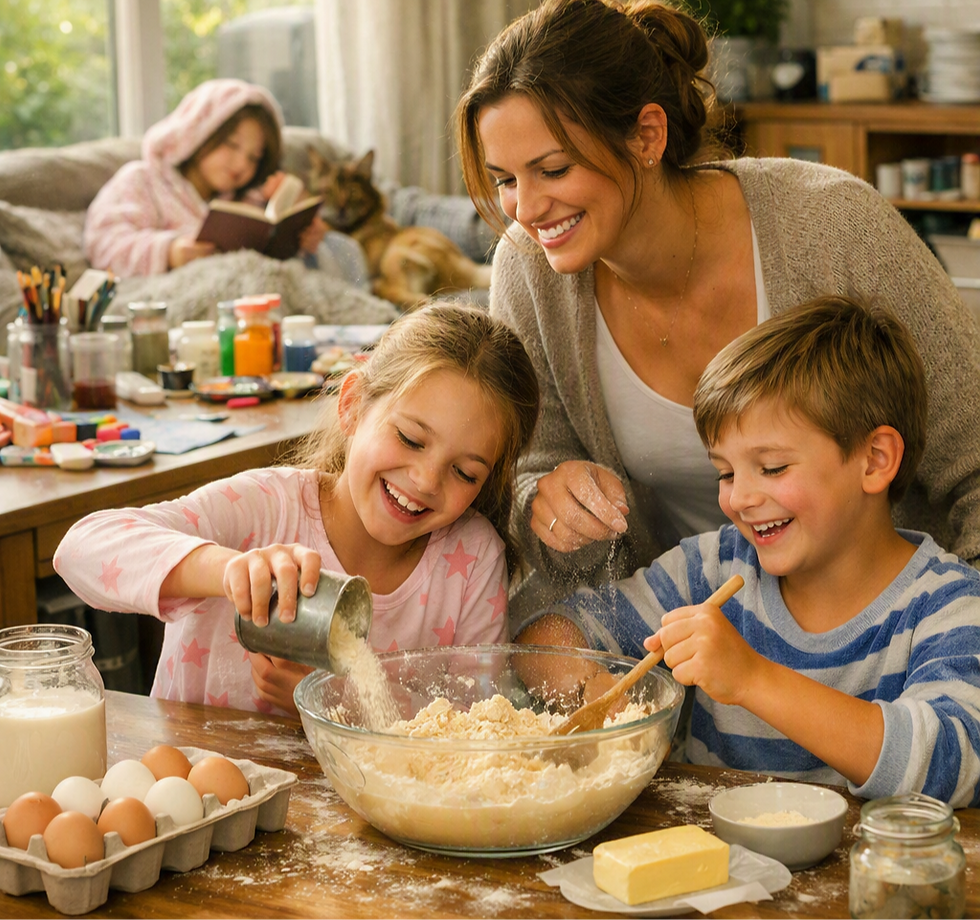
Spend time together outdoors, bake, paint, wander, talk. Invite your child into the process rather than directing it. Build in quiet days and unstructured hours — even boredom has value; it’s the space where imagination wakes up again.
You don’t need formal lessons right now—books, nature walks, podcasts, cooking, and conversations all count as learning. The goal isn’t to replicate school at home — it’s to remember what learning feels like when it’s alive and personal.
How Long Does Deschooling Take?
There’s no fixed timeline — it’s more about readiness than rules. A common guide is to allow roughly one month of deschooling for every year your child spent in school, though even a few weeks can make a meaningful difference.
Some families use the summer months as a natural transition; others take longer, easing into homeschooling when everyone feels settled again. You’ll know it’s time when the tension softens, curiosity returns, and learning begins to unfold naturally — not because it’s scheduled, but because it’s wanted. It’s not only about your child’s readiness — it’s about yours too.
Deschooling ends when you, as the parent, begin to let go of school‑shaped expectations and start to see learning as something fluid and personal that can be woven into daily life and doesn't need to look like school at home. When you understand that homeschooling can look different for every family — and that your approach doesn’t have to mirror anyone else’s — that’s the moment you’ve both moved beyond deschooling and into genuine home education.
What Deschooling Might Look Like:
Deschooling is not a holiday, though it may feel restful. It is not chaos, though it may feel unstructured. It is not avoidance, though it may involve stepping back from formal academics.
It is a temporary period of transition that often looks like:
long conversations over breakfast
reading together without analysing every chapter
exploring interests that were previously “extras”
baking, building, wandering, noticing
reconnecting with nature, with community, with each other
letting curiosity lead instead of a timetable
It looks like life — lived with intention.
Some days will feel productive. Others will feel slow. All of it is learning.
How Deschooling Differs from Unschooling:
Deschooling is temporary.
Unschooling is a philosophy.
Deschooling is the transition—the clearing out old assumptions so you can see your child’s learning clearly.
Unschooling is one possible path you may choose afterwards, where learning continues to be child-led and interest-driven, with parents facilitating learning through strewing and supporting, rather than assigning.
You can deschool and then move into structured homeschooling.
You can deschool and then unschool.
You can deschool and blend approaches.


Share your deschooling experiences with us. What did deschooling look like in your home? How do you feel your homeschooling journey has benefited from deschooling at the start? What did you learn from your deschooling experiences? 😍